
Phishing is a type of cyberattack that uses fraudulent communications, typically emails, text messages or websites, to trick people into revealing sensitive information such as passwords, credit-card numbers or corporate credentials.
The most effective training combines foundational education on attack types with ongoing simulated phishing exercises. These exercises reinforce recognition skills in real-world scenarios.
This complete guide explains what phishing is, how attacks have evolved in 2026, and how organizations can build effective awareness programs that reduce risk and meet compliance requirements.
Attackers continuously refine their techniques, and the employees who interact with emails, links and messages every day remain the primary target. What follows is a practitioner-focused breakdown of phishing fundamentals, emerging AI-driven threats and the training frameworks that turn your workforce into a frontline defense.
What is phishing?
Phishing involves sending fraudulent communications that appear to come from a legitimate source, designed to deceive recipients into harmful actions. It includes any attempt to steal sensitive information, usernames, passwords, financial data or access credentials, by masquerading as a trustworthy entity.
Phishing exploits human psychology rather than technical vulnerabilities. Attackers craft messages that create urgency, fear or curiosity, prompting recipients to click malicious links, download infected attachments or enter credentials on fake websites.
A phishing link directs users to a fraudulent page designed to harvest information, while a phishing website mimics legitimate sites with convincing accuracy.
What is the goal of phishing?
The goal of phishing is typically one of three outcomes: credential theft, malware installation or financial fraud. Credential theft gives attackers access to corporate systems, email accounts or sensitive databases. Malware installation can lead to ransomware deployment, data exfiltration or persistent network access. Financial fraud directly targets bank accounts, payment systems or wire transfers.
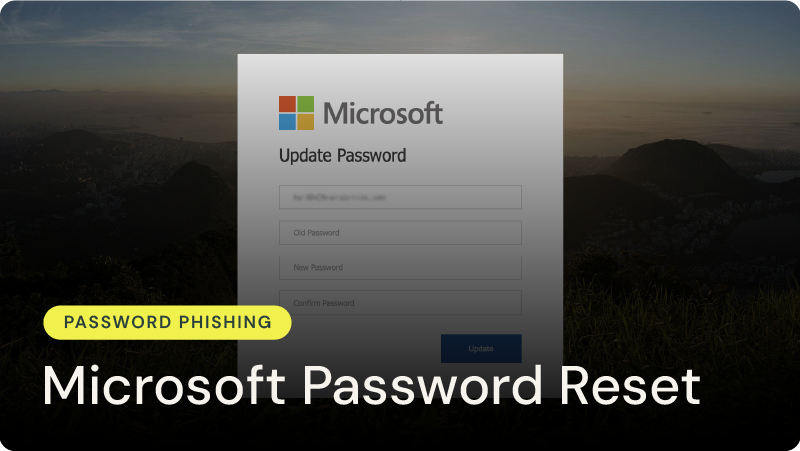
In the example above, you can see a realistic phishing tactic that resembles Microsoft's password reset page. Phishing scams have become increasingly sophisticated since the term emerged in the mid-1990s. What began as crude mass emails with obvious spelling errors has evolved into highly targeted campaigns that exploit personal information, corporate branding and psychological manipulation.
For organizations, this evolution means static, one-time training is insufficient. Employees need continuous education that keeps pace with attacker innovation.
Types of phishing attacks: spear phishing, smishing, vishing and more
Phishing attacks fall into several distinct categories, each defined by the delivery method, target specificity or technique employed. Understanding the different types of phishing is essential for building training programs that address the full threat landscape.
Spear phishing is a targeted attack aimed at specific individuals or organizations. Unlike mass phishing, which casts a wide net, spear phishing uses personalized details such as names, job titles, recent transactions or internal project information to appear credible. The key distinction is precision: general phishing relies on volume, while spear phishing invests in research to compromise high-value targets.
Whaling is a subset of spear phishing that targets senior executives, board members or other high-profile individuals. These attacks often impersonate trusted partners, legal counsel or fellow executives to authorize fraudulent wire transfers or access sensitive strategic information.
Smishing refers to phishing delivered via SMS text messages. Attackers exploit the immediacy and trust associated with texting, often posing as banks, delivery services or IT departments. Understanding what smishing and phishing share, as well as how they differ, helps employees recognize threats across all communication channels, not just email.
Vishing is voice phishing conducted through phone calls. Attackers may pose as technical support, government agencies or internal IT staff, using social engineering to extract credentials or convince targets to install remote-access software.
Clone phishing involves creating a near-identical copy of a legitimate email the recipient has previously received, replacing links or attachments with malicious versions. The familiarity of the original message lowers the recipient's guard.
QR code phishing (sometimes called "quishing") embeds malicious URLs within QR codes placed in emails, physical locations or documents. As QR code usage has expanded, attackers have exploited the difficulty of previewing a URL before scanning.
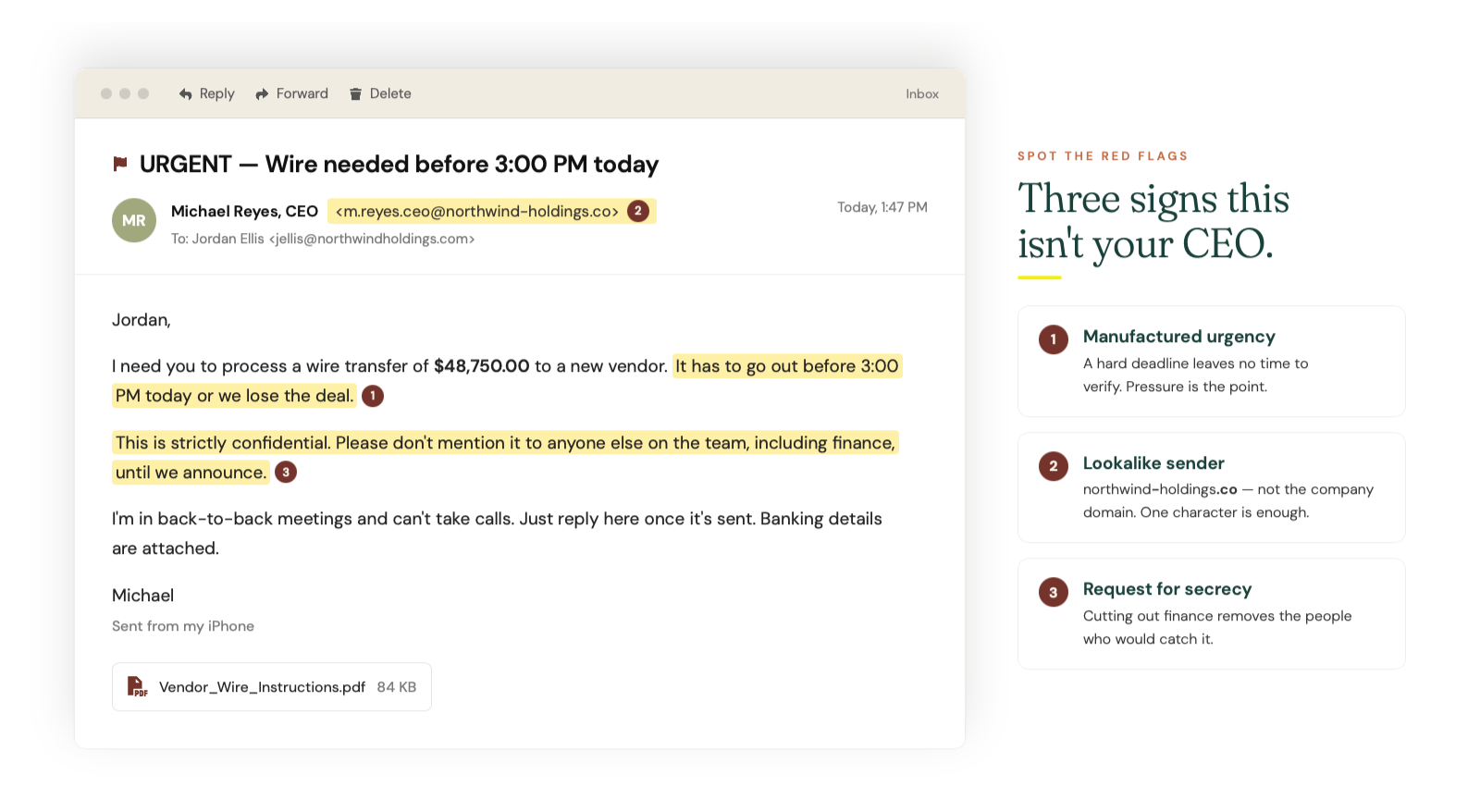
Business email compromise (BEC) involves attackers gaining access to or spoofing corporate email accounts to request fraudulent payments, redirect invoices or steal sensitive data. BEC attacks often bypass technical filters because they contain no malicious links or attachments. The attack is the social engineering itself.
Each attack type requires specific recognition skills. Effective training programs address this diversity by exposing employees to examples across categories, building pattern recognition that transfers across delivery methods.
How to identify a phishing attack
Recognizing a phishing attack requires employees to identify specific warning signs that distinguish fraudulent communications from legitimate ones. Training programs that pair awareness education with security awareness and phishing simulation build lasting recognition skills that employees apply instinctively.
Sender address anomalies are among the most reliable indicators. Attackers often use domains that closely resemble legitimate ones, substituting characters, adding subdomains or using lookalike spellings. Employees should verify sender addresses carefully, especially when messages request sensitive actions.
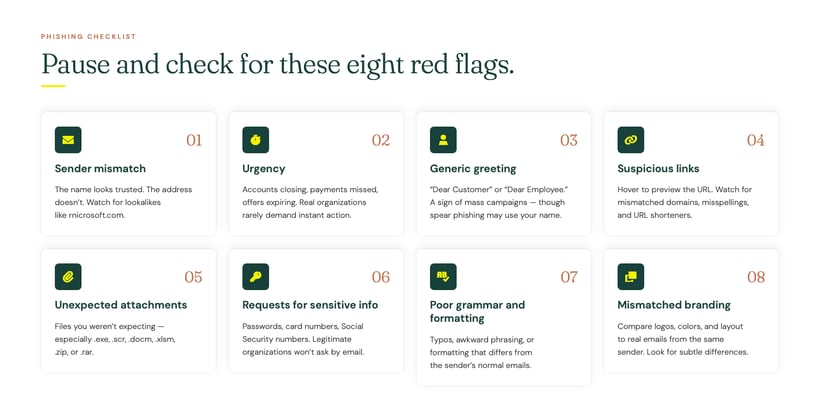
Urgency and pressure tactics are hallmarks of phishing. Messages claiming accounts will be suspended, payments are overdue or immediate action is required exploit emotional responses that override careful evaluation. Legitimate organizations rarely demand instant action through email.
Generic greetings and impersonal language often signal mass phishing campaigns. Messages addressing "Dear Customer" or "Account Holder" rather than using the recipient's name may indicate the sender lacks legitimate access to customer data.
Suspicious links and attachments require careful scrutiny. Hovering over links, without clicking, reveals the actual destination URL. Shortened URLs, misspelled domains or unexpected file attachments, especially executable files or macro-enabled documents, warrant immediate suspicion.
Requests for sensitive information should trigger verification protocols. Legitimate organizations do not request passwords, social security numbers or payment details through email. Any such request should be verified through official channels.
Poor grammar and formatting remain indicators, though sophisticated attackers increasingly produce polished content. Inconsistent branding, unusual formatting or mismatched logos may still reveal fraudulent messages.
Mismatched context is particularly important for spear phishing detection. Messages referencing projects, transactions or relationships that don't align with the recipient's actual work should prompt verification before any action is taken.
Building these recognition skills requires more than a single training session. Ongoing simulated phishing exercises reinforce learning by providing safe opportunities to practice identification in realistic scenarios.
AI-driven phishing threats in 2026
AI-powered phishing represents the most significant evolution in attack sophistication, enabling threat actors to generate highly convincing, personalized attacks at unprecedented scale.
Organizations preparing for 2026 and beyond must understand how artificial intelligence is transforming the threat landscape.
AI-generated spear phishing uses large language models to craft messages that mimic the style, tone and context of legitimate communications. By analyzing publicly available information, social media posts, corporate announcements and LinkedIn profiles, attackers can generate personalized messages that reference real projects, colleagues or recent events, creating phishing content that passes the "gut check" many employees rely on.
Deepfake-enabled vishing uses voice-cloning technology to impersonate executives, IT staff or trusted partners in phone calls. An attacker with audio samples, from earnings calls, conference presentations or social media, can create convincing voice impersonations that authorize fraudulent transactions or extract sensitive information.
Automated reconnaissance allows attackers to gather and synthesize target information at scale. AI tools can scrape organizational charts, identify reporting relationships and map communication patterns to identify the most effective attack vectors for each target.
Real-time adaptation enables phishing campaigns to adjust messaging based on recipient responses. AI systems can modify follow-up messages, escalate urgency or shift tactics based on whether initial attempts succeed or fail.
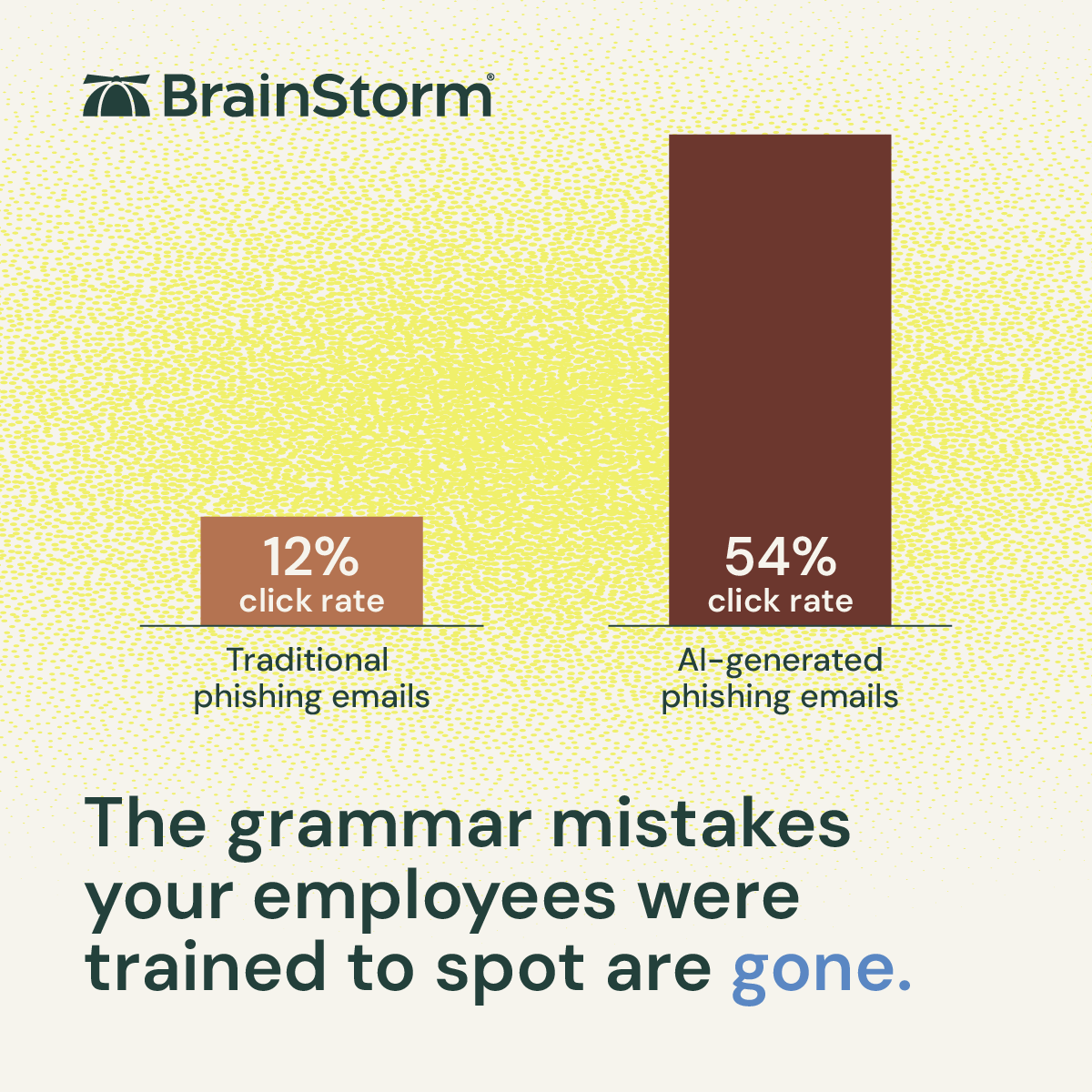
These developments make traditional detection methods less reliable. Employees can no longer rely solely on spotting grammatical errors or generic content, since AI-generated phishing often lacks both. Organizations must adapt their training programs to address this reality.
For deeper analysis of how these threats are reshaping organizational security postures, BrainStorm's State of Cybersecurity research provides benchmark data on evolving attack patterns. The Is Phishing Prevention Possible? webinar offers expert perspectives on whether modern phishing can realistically be prevented given AI-driven capabilities.
AI amplifies attacker capabilities, but it also creates opportunities for defenders. AI-powered training platforms can generate dynamic simulations, personalize learning paths and identify employees who need additional support, matching attacker sophistication with defender preparation.
How to protect your organization from phishing
Protecting your organization from phishing requires a layered defense strategy that combines technical controls, policy frameworks and human-centered training. No single solution eliminates phishing risk. Effective protection integrates multiple approaches.
Email filtering and authentication form the technical foundation. Implementing Sender Policy Framework (SPF), DomainKeys Identified Mail (DKIM) and Domain-based Message Authentication, Reporting and Conformance (DMARC) protocols helps prevent email spoofing. Advanced email security gateways can detect malicious links, sandbox suspicious attachments and flag messages from newly registered domains.
Multi-factor authentication (MFA) significantly reduces the impact of credential theft. Even when phishing successfully captures passwords, MFA prevents attackers from accessing accounts without the second authentication factor.
Endpoint protection provides an additional layer by detecting and blocking malware delivered through phishing. Modern endpoint detection and response (EDR) solutions can identify suspicious behavior patterns even when initial delivery evades email filters.
Incident response protocols ensure rapid containment when phishing succeeds. Clear reporting channels, defined escalation procedures and practiced response playbooks minimize damage and accelerate recovery.
Employee training is the most critical protection layer because phishing targets human decision-making. Technical controls can filter many threats, but sophisticated attacks, especially AI-enhanced spear phishing, often bypass automated defenses. Understanding how phishing training for employees can prevent human error is essential for security leaders building comprehensive defense strategies.
Verification culture establishes organizational norms around confirming sensitive requests through secondary channels. When employees routinely verify wire transfer requests, credential resets or unusual instructions through phone or in-person confirmation, social engineering attacks become significantly harder to execute.
Regular security assessments identify gaps in both technical controls and human awareness. Penetration testing, phishing simulations and security audits provide visibility into organizational vulnerabilities before attackers exploit them.
Phishing is not solely a technical problem. It is a human problem that requires human-centered solutions: training programs that build genuine recognition skills, not just checkbox compliance.
Phishing awareness training for compliance and risk reduction
Phishing awareness training serves dual purposes: reducing organizational risk exposure and satisfying regulatory compliance requirements. For compliance champions in regulated industries, effective training programs must accomplish both objectives simultaneously.
Regulatory frameworks including HIPAA, PCI-DSS, SOX and various state privacy laws mandate security awareness training for employees with access to sensitive data. Audit requirements typically specify training frequency, content coverage and documentation of completion. Organizations that fail to demonstrate adequate training face penalties, audit findings and increased liability exposure.
However, compliance-driven training that focuses solely on checkbox completion fails to achieve meaningful risk reduction. Employees who complete annual training modules without genuine engagement remain vulnerable to sophisticated attacks. The gap between compliance and effectiveness represents significant organizational risk.
Effective training programs bridge this gap by combining compliance documentation with genuine behavior change. Phishing awareness training that prevents risk goes beyond annual modules to include ongoing reinforcement, simulated attacks and measurable skill development.
Simulated phishing exercises provide the most direct measure of training effectiveness. By sending controlled phishing attempts to employees and tracking click rates, reporting rates and credential submission rates, organizations gain visibility into actual vulnerability levels. Understanding what a successful simulated phishing training program looks like helps security leaders design programs that generate meaningful metrics.
Continuous learning replaces annual training events with ongoing micro-learning and just-in-time education triggered by simulated failures, with regular updates on emerging threats. This approach maintains awareness throughout the year rather than creating brief spikes followed by gradual decay.
Metrics and reporting satisfy audit requirements while providing actionable intelligence. Tracking improvement over time, identifying high-risk departments and correlating training completion with simulation performance enables data-driven program refinement.
For organizations in regulated industries, the most effective approach treats compliance as a floor, not a ceiling. Meeting minimum requirements protects against audit findings. Exceeding them protects against actual attacks.
Build a security-conscious workforce with BrainStorm
Building a security-conscious workforce requires training that changes employee behavior, not just awareness. BrainStorm's approach to phishing education combines foundational knowledge with practical simulation to create lasting recognition skills across your organization.
Effective security culture extends beyond the IT department. When every employee, from entry-level staff to senior executives, understands their role in organizational defense, they create a human firewall that technical controls alone cannot provide against phishing attacks.
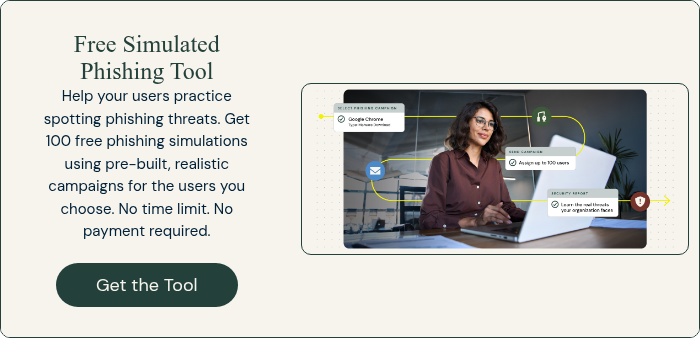
BrainStorm's free simulated phishing tool lets you run a phishing attack simulation at no cost and see exactly where your employees' recognition gaps are. It covers the full spectrum of phishing, from mass campaigns to targeted spear phishing, so you know where to focus training before you invest in anything else.
The platform delivers training that adapts to individual learning needs, providing additional support for employees who struggle with recognition while advancing those who demonstrate proficiency. This personalized approach maximizes training efficiency while ensuring no employee falls through the gaps.
For security experts responsible for reducing phishing-related incidents, BrainStorm provides the metrics and reporting needed to demonstrate program effectiveness to leadership and auditors. For compliance champions, the platform generates documentation that satisfies regulatory requirements while delivering genuine risk reduction.
Ready to change how your organization recognizes and reports phishing attempts? Access the free simulated phishing tool to see exactly how BrainStorm can help you build a workforce that stops phishing before it causes harm.
Understand Phishing Risk For Free
Access our no-cost simulated phishing tool
No Payment Info Required!
Access Simulated Phishing ToolReady to meet with our team?
Request a Demo