Last updated: November 1, 2026. Prices and model names come from Anthropic's published pages as of this date. Check Anthropic's pricing page before you budget.
Claude comes in four model classes. Haiku 5.5 is the fastest and cheapest, at $0.10 per million input tokens for prompts up to 100,000 tokens. Sonnet 5.5 is the everyday workhorse at $2. Opus 5.5 costs $4 and handles long agentic work. Fable 5.1 costs $10 and is built for the hardest tasks.
Picking the right one is a cost decision and a results decision. This guide gives you the prices, the differences, and a simple way to choose.
What are the Claude models?
Claude is Anthropic's family of AI models. Each class is built for a different job, and the classes trade capability against speed and price.
- Fable 5.1: for demanding reasoning and long-horizon agentic work.
- Opus 5.5: for long-running agentic coding and knowledge work.
- Sonnet 5.5: the best combination of speed and intelligence.
- Haiku 5.5: for high-volume, latency-sensitive tasks such as classification, extraction, and routing.
All four current models support text and image input, text output, multiple languages, vision, and tool use. Each has a 1M token context window and a 128K token maximum output, according to Anthropic's models overview. One token is a small chunk of text, and 1M tokens is roughly 750,000 words on the current tokenizer.
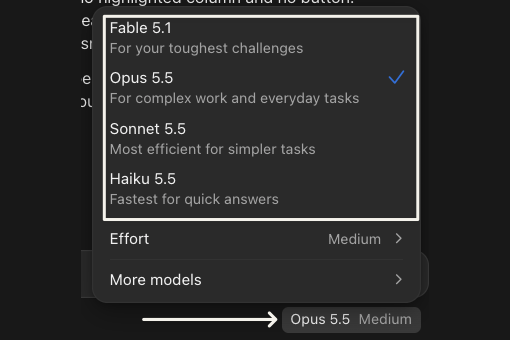
Anthropic also lists Mythos models, which are limited to organizations in verified programs. This guide excludes the Mythos models and only covers the models most teams can use.
How much does each Claude model cost?
API pricing is per million tokens (MTok). You pay one rate for what you send in (input) and a higher rate for what the model writes back (output).
Table: Claude API prices in USD per million tokens, from Anthropic's pricing page, November 2026.
Two details matter for budgeting:
- Haiku 5.5 costs more for long prompts. Above 100,000 input tokens, it runs $0.50 input and $2.50 output per million tokens.
- The Batch API takes 50% off input and output for work that can wait. Prompt caching bills repeated context at the much lower cache read rate.
How much do the Claude plans cost?
If you use Claude in the app instead of the API, you pay a subscription. Prices below are from Claude's pricing page and Help Center.
Table: Claude plan prices in USD, November 2026. Prices exclude tax and can change.
Team plans start at two members and support up to 150 seats. Enterprise has no per-seat usage limits, so your bill scales with what your people run.
Why token price is not task price
A low token price does not guarantee a low cost per finished task. Models spend different numbers of tokens on the same work. Anthropic makes this point itself: more capable models often need fewer turns and less thinking time, so cost per task can be lower even when price per token is higher.
What is the difference between Opus, Sonnet, Haiku, and Fable?
The classes differ in how hard a problem they can reliably carry, and what that costs in price and speed. Anthropic says its model classes do not specialize by industry. Every Claude model is trained for coding, agentic tasks, and knowledge work.
Table: Claude model comparison, from Anthropic's models overview and model selection guide.
Claude Fable 5.1
Fable is the most capable model and the most expensive. Anthropic's guidance is to move to Fable when Opus struggles on your tasks, even at higher effort. Larger models like Fable tend to show more wisdom, creativity, and writing skill in real work.
Claude Opus 5.5
Opus is the reasoning-heavy enterprise model. It is where Anthropic suggests most workloads start. If Opus already clears your quality bar, its speed and price may make it the better choice over Fable.
Claude Sonnet 5.5
Sonnet is the versatile everyday model. It balances performance, cost, and speed for the widest set of uses, including high-volume subagents in multi-agent setups. If you are unsure where to begin in the Claude app, Claude Academy suggests starting here.
Claude Haiku 5.5
Haiku is the lowest-cost, fastest class. It fits work where latency and price drive the decision, such as routing requests, extracting fields, and classifying text.
Which Claude model should you use?
Match the model to how hard the task is, how fast you need an answer, and how many times you will run it.
Table: Which Claude model to start with, based on Anthropic's model selection matrix.
Start capability-first or efficiency-first
Anthropic describes two approaches. Efficiency-first starts with Haiku 5.5, tests thoroughly, and upgrades only when you hit a capability gap. It suits prototypes, tight latency needs, and high-volume simple work.
Capability-first starts with Opus 5.5, tunes your prompts, then looks for savings by lowering effort or moving to a smaller model. It suits complex reasoning and cases where accuracy outweighs cost. Anthropic's own default advice is to start with the most intelligent generally available model and use effort to dial in cost.
Use the effort setting before you switch models
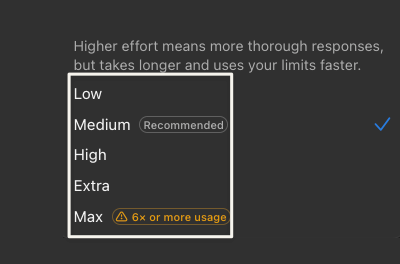
Several Claude models have an effort setting that trades intelligence for speed and cost inside one model. Anthropic says tuning effort is often a better lever than switching models. Defaults differ: Fable 5.1 and Sonnet 5.5 default to high, and Opus 5.5 and Haiku 5.5 default to medium. Set effort on purpose when you compare models, or you will compare unlike settings.
Is the cheaper Claude model really cheaper?
Sometimes. Independent analysis of Anthropic's own benchmark charts, published by Digital Applied on September 28, 2026, found this:
- Up to about $2 per task, Sonnet 5.5 scored higher on three of the four benchmarks charted.
- At about $5 per task, Opus 5.5 at medium or high scored higher on all four.
- At each model's API default, Opus 5.5 scored higher on every chart and cost between 11% and 90% more per task.
The right answer depends on what a failed task costs you. If a person has to fix every miss, a higher score can be cheaper overall. If a script checks the output and can retry, Sonnet 5.5 at high is a natural place to start.
Treat these figures with care. The points are vendor-run, and they reflect specific benchmarks. Run a small test on your own work before you commit a budget.
How do you roll Claude out to a team?
Purchasing licenses is the easy part. The hard part is getting people to use it well.
Imagine an IT director who purchases Claude licenses for 2,000 employees and selects the right model. Three months later, only a small group uses it daily, while most never even open it. Those who do are using the most expensive setting for tasks that Haiku could handle. The tool works; adoption does not.
That gap is a behavior problem, and it follows a pattern. BrainStorm's ADOPT™ framework maps it: Awareness, Desire, Orientation, Participation, Transformation. Model choice shows up most in Orientation, where people learn which model fits which task, and in Participation, where they use it in daily work.
Here is what moves adoption:
-
Teach by role, so an analyst, a developer, and a support lead learn their own best use.
-
Show people which model and effort level fit which task, so they stop defaulting to the most expensive option.
-
Reach people who never visit a training site with short nudges tied to real usage.
-
Measure behavior, not course completions, so you can show leadership the ROI.
If you want to get more from your Claude rollout, contact us or explore our Claude content pack to see how BrainStorm can help your team become confident, secure power users.