SCORM has been around long enough that, for many learning professionals, the word comes with baggage: a forty-five-minute slide deck with a Next button, a quiz at the end, and an LMS patiently waiting to record Complete.
That experience is common, but it isn't SCORM!
SCORM is just the vehicle that brought you those poorly built experiences. And that distinction matters. To see why, it helps to step outside learning technology for a second and look at a standard you already trust without thinking about it.
SCORM is more like USB than a course format
Maybe an analogy can be helpful...bear with me. We've all used USB as a standard way to connect devices to share data and energy.
USB ports have been everywhere for years (airports, hotels, rental cars, conference rooms) and if you had the right cable, it just worked.
Devices that don't connect using USB ports are hard to buy because it's so embedded in our everyday lives. That's the interesting thing about standards: once one becomes widespread, interoperability creates enormous value, but its conventions can outlive the technology itself.
SCORM has that same dynamic: its ubiquity is part of its strength. A SCORM package moves between systems because so much of the learning ecosystem understands the standard. But over time, the industry built assumptions about what a package is supposed to look like, and what we want is the interoperability without inheriting those assumptions.
SCORM the Standard vs. SCORM the Convention
You'd never look at the USB port on your computer and say "that's specifically for my Lenovo keyboard". It's the same with SCORM. At its core, it's a standard, not content structure.
SCORM is a packaging and communication standard for web-based learning content. It bundles an HTML/JavaScript experience into a portable package that can be launched in a compatible platform. So, why do we limit it to the old look and feel of learning content?
The problem is that authoring tools and LMSs increasingly treated the package as the course itself — a thirty, forty-five-minute, or multi-hour course built as one giant object, uploaded, launched, and recorded as a single line item. Over time, "SCORM" and "big click-through e-learning course" became almost synonymous. That convention is what we reject—not the underlying idea of SCORM.
What is SCORM uniquely good at?
Principle 1: Keep the interactive canvas
One answer is interactivity. HTML and JavaScript give us a flexible canvas for learning experiences that would be weaker as a PDF or video. That's the idea behind interactive microlearning assets: self-contained, portable web experiences we make the learning object itself.
A Module might use:
- Flip cards
- Hotspots
- Drag-to-match activities
- Expandable accordions
- Tabbed content
- Timelines
- Click-to-reveal interactions
- Mixed media
- Other interactive elements we decide are valuable
We aren't limited to a fixed catalog, so when we see a pattern that could create a better experience, we can build it. But the goal isn't interactivity for its own sake; the important word is better.
Principle 2: Interaction can create desirable difficulty
Text documents are efficient — sometimes too efficient. A learner can drag the scrollbar to the bottom and technically have "seen" everything on the page. A well-designed interactive module asks a little more: predict an answer, explore hotspots, connect two ideas, categorize an example, or move through information deliberately instead of skimming past it.
Cognitive psychologist Robert Bjork named this desirable difficulty: enough effort to engage a learner cognitively, without making learning frustrating. A click by itself isn't learning; a click that asks someone to predict, recognize a pattern, or connect two concepts can be.
Principle 3: A module should be a learning moment, not a mini course
This philosophy also explains what we should deliberately avoid: a module shouldn't contain a sprawling, multi-hour course, or trap every assessment and survey inside the package.
Instead, a module should be sized around a focused learning moment — teach a concept, help someone explore a scenario, show a relationship that's hard to communicate in a static document, practice a choice, break down a process, or create a short experience that benefits from interaction. That constraint is intentional.
A module built around one new feature, sent the week it ships, does more for adoption than a forty-five-minute 'what's new in this release' course ever could.
Principle 4: Choose the format because it fits the learning
None of this means modules are automatically better than videos or articles. A two-minute demonstration may work better as a video; a reference someone returns to repeatedly, as an article; a simple reminder may need no asset at all. The module strategy adds another format to our toolbox for situations where interaction genuinely strengthens the experience — creating variety, introducing desirable difficulty, combining media, or engaging learners before moving on.
We don't exist to manufacture course completions — our larger goal is to help people change what they do. Content formats should be chosen based on the behavior we're trying to create, not because one format has historically been the default.
We don't need SCORM to be the learning platform
Traditional LMS architecture asks the SCORM package to do a lot (content, sequencing, navigation, assessment, branching, and completion logic) while the platform around it acts as little more than a launcher and record keeper.
At BrainStorm, we already have a platform built to orchestrate a broader learning and adoption experience.
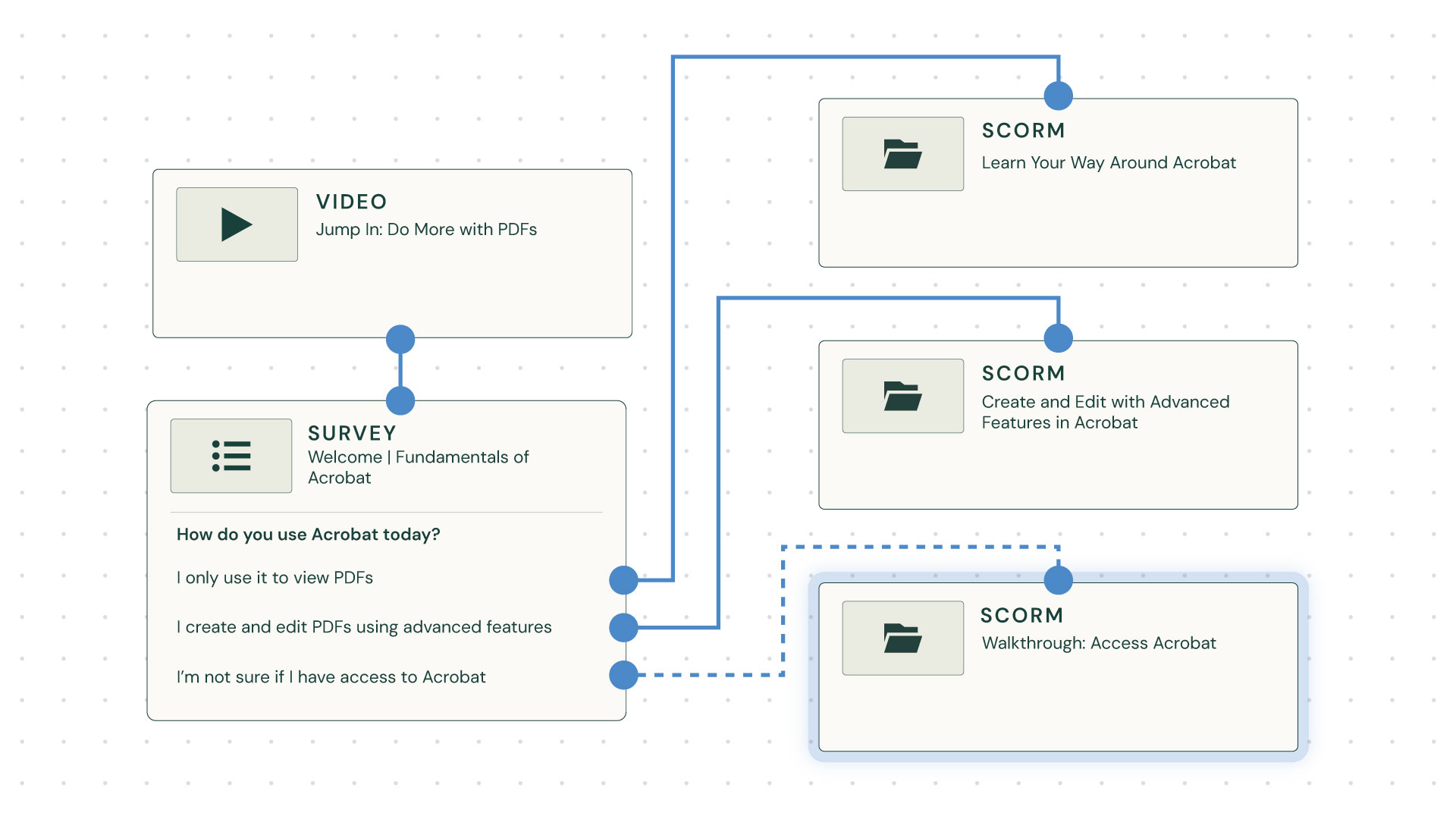
We can determine what someone sees, sequence learning moments, use assessments and surveys where they make sense, measure engagement, and reinforce ideas over time. We don't need to rebuild a miniature learning platform inside every SCORM package — doing so would work against how we think about behavior change.
People rarely change how they work because they completed one giant course. Change happens through repeated, purposeful interactions over time…not one package.
SCORM isn't the strategy
That brings us back to USB. USB tells devices how to connect; it doesn't tell you what device to build. Similarly, SCORM gives us a mechanism for packaging an interactive web experience — it doesn't dictate that the experience has to be a forty-five-minute course, contain fifty slides, end in a quiz, or become a learning journey unto itself. Those were design choices the industry layered on top of the standard.
We can make different choices, and think of SCORM as plumbing rather than pedagogy. The interesting part isn't the package — it's what we choose to put inside it.
If you want to see what that looks like in practice, our SCORM page walks through how modules fit into the broader platform. And if you're sitting on a library of forty-five minute SCORM courses and wondering what it takes to modernize them, our SCORM Transition Services team can help.
Connect with the author on LinkedIn: Todd Kirk | LinkedIn
More from BrainStorm