Every customer education team eventually has the same conversation with leadership. Someone asks if the program is driving product adoption. The answer on hand is usually a dashboard: completions, attendance, and certifications earned.
Those numbers are real. They just don't answer the question being asked.
The real question is simpler. Did customers do something differently after the training? Whether they finished the course matters less than that.
Part of why this is hard is structural. Product adoption data lives in one system. Learning activity lives in another. The connection between them usually already exists somewhere in the business. It just hasn't been made visible to the people who need it.
The case for customer education is already strong on paper.
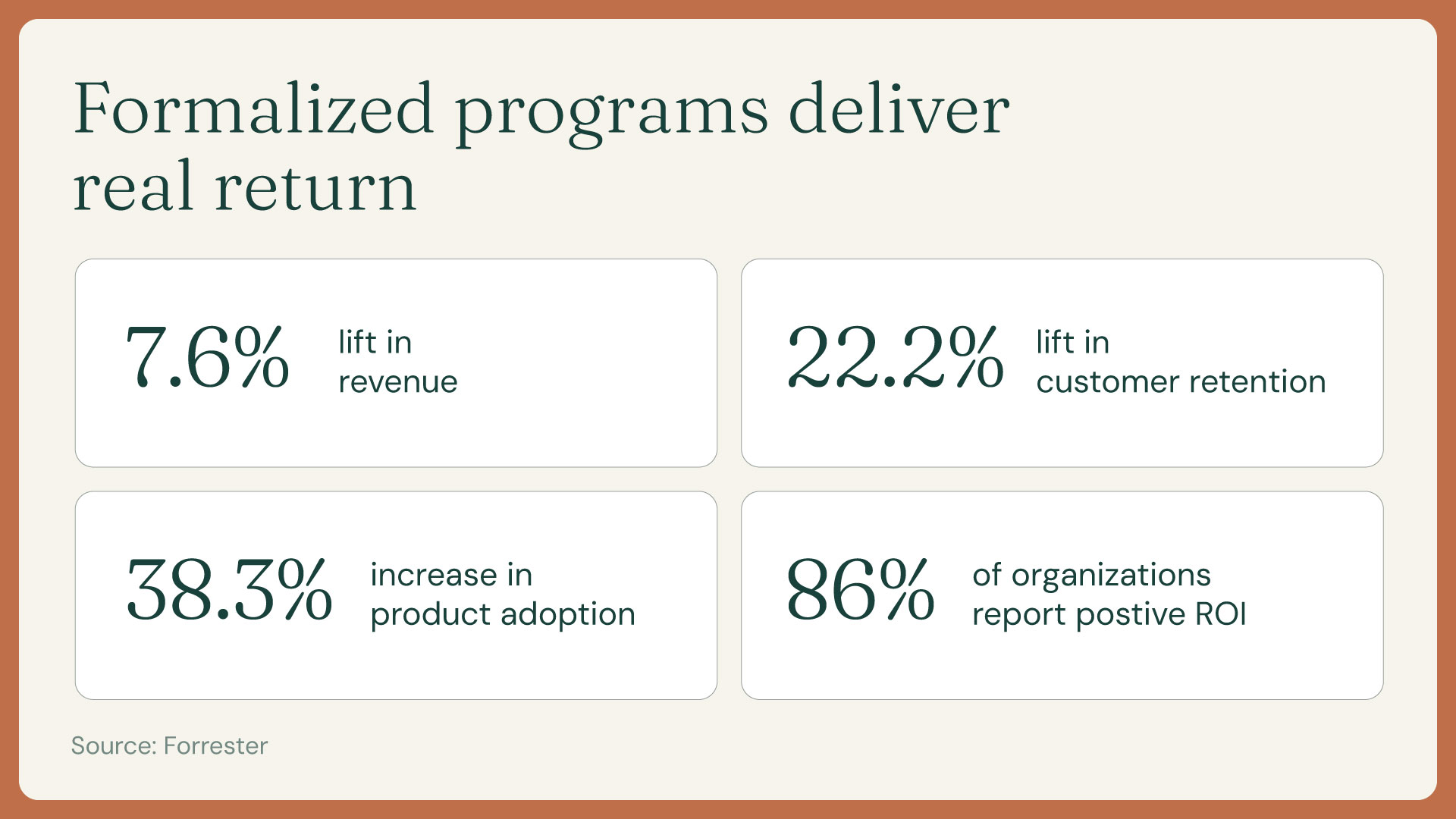
According to a Forrester study, formalized programs are linked to a 7.6% lift in revenue and a 22.2% lift in customer retention. Products targeted by training see a 38.3% increase in adoption. Eighty-six percent of organizations report a positive return on their education investment, and 96% have at least broken even.
Those numbers make a good opening slide, but they don't prove your program is working. Proving that takes a framework built from your own data, not someone else's benchmark.
Start with behaviors, not completions
Most product teams already know which actions separate a customer who's succeeding from one who isn't. Maybe it's turning on a specific feature. Maybe it's building out a workflow. Maybe it's inviting teammates or generating a report on a recurring basis.
Those are the behaviors worth tracking. Completion data should support that picture. It shouldn't stand in for it.
Reframing the question makes this concrete. Instead of asking how many customers completed a course, ask something sharper. Did trained customers adopt the feature more often? Did they adopt it faster? Did they use it more consistently over time, compared to customers who never took the training at all?
Each of those questions is answerable with data you likely already have. Each one moves the conversation from activity to outcome.
Find the data you already have
Measuring this rarely requires new technology. Product usage data already exists somewhere in most businesses. Learning activity already exists somewhere else. The real obstacle is usually connecting the two, not collecting either one for the first time.
Before evaluating a new tool, sit down with whoever owns product analytics. Ask three things.
- Which of the behaviors you've identified are already being tracked?
- Can customers be matched across the two systems, using something like an account ID or email domain?
- How far back does the usable history go?
Most customer education teams are closer to measurement than they expect. The gap is usually a missing conversation, not missing data.
Build a simple comparison before a sophisticated one
You don't need a perfect model to start learning something useful. Compare customers who engaged with relevant education against customers who didn't, using the same time window for both groups. Useful angles include time to adoption, frequency of use, feature depth, renewal rates and support ticket volume.
This won't prove causation on its own, and it's worth saying that plainly rather than overselling a spreadsheet comparison as a controlled study. What it does provide is a credible signal. It shows where education appears to change behavior, and where it doesn't. That's enough to improve the program and start building a real business case.
Translate the gap into numbers leadership already tracks
A behavior gap only becomes persuasive once it's priced. Take whatever comparison you ran above. Attach it to a number your customer success or revenue team already watches.
If trained customers renew at a higher rate, that's a retention number. If they submit fewer "how do I" tickets, that's a support cost number. If they use more of the product, that's an expansion number for your CRO.
Do the multiplication once. A renewal lift, multiplied by average contract value. A ticket reduction, multiplied by cost per ticket. An expansion rate, multiplied by average upsell size. Each one turns a percentage into a dollar figure. Executives ask for evidence that behavior changed, priced in terms they already use.
Let monetization make the case directly
That translation works once you already have behavior data to work with. Some customer education teams skip the wait. They build the revenue case directly into the course itself.
One version of this is simple. Add a short, low-pressure question inside a course or module, something like: "Would you like to learn about this feature next?" When a software vendor is preparing to launch a new feature or a higher pricing tier, that single question does two jobs at once. It tells you whether the content is landing. It also hands sales a qualified upsell or cross-sell signal, tied to a specific customer and a specific feature.
Tiered content and paid certification programs work the same way, just at a larger scale. They turn education from a line-item leadership tolerates into one they can watch grow.
Where this leaves you
None of this requires an additional headcount to start. It requires choosing one feature, defining the behavior that would prove adoption and running the comparison honestly, even when the results aren't flattering.
If you try this and the data doesn't exist yet, that's worth investigating on its own. It usually means your current platform can't connect learning activity to product usage in the first place. That's also the clearest sign it's time to look at whether your customer education LMS is still the right one.
Keep Reading