Get Blog Updates
Which AI Adoption Zone are your users in?
The 4 Zones of Enterprise AI Adoption
Posted May 12, 2026 — BrainStorm Inc.
Most leaders ask the wrong question about AI.
"Is our team using AI?" sounds reasonable. It's how usage shows up in dashboards. It's the answer the board wants. But it flattens what's actually happening in the org down to a single yes-or-no, and it hides the gap that decides whether your AI investment ever pays off.
The better question: which zone are they in?
At any enterprise rolling out AI, your workforce isn't one population. It's four. Each zone uses (or avoids) AI in a different way. Each zone carries a different hidden risk. Each one needs a different intervention to move forward.
Here's the playbook.
The four zones, briefly
Before the moves, a quick map of the territory.
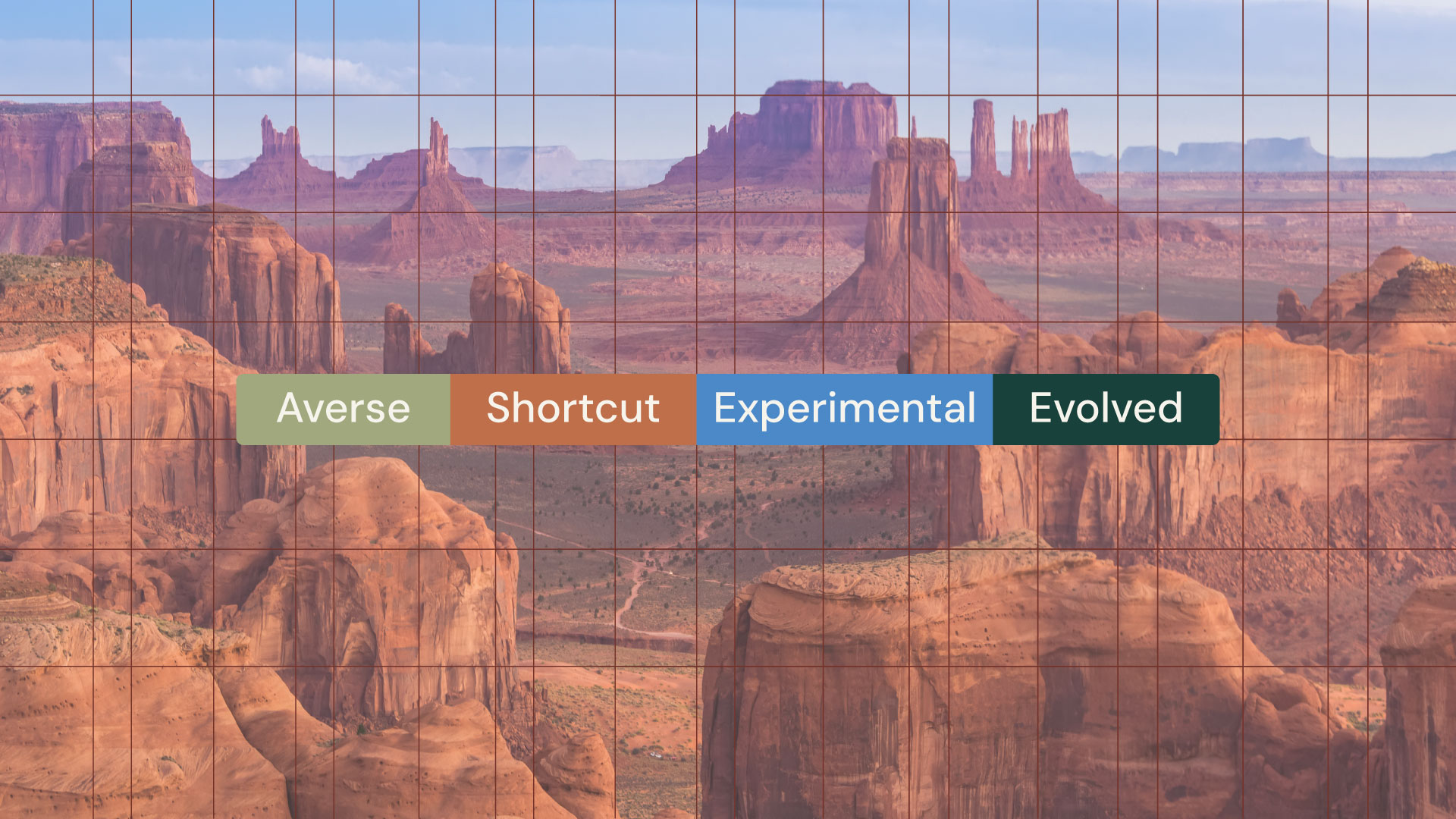
Averse users.
Fearful, overwhelmed or actively opposed. AI feels like a threat or hype, not a tool.
Shortcut users.
Doing the same work the same way, just faster. AI as a typing assistant. This is where most of your workforce lives.
Experimental users.
Reimagining workflows, but stuck on data access, connectors or authority to ship anything real.
Evolved users.
Redefining what work means. AI-native operating models, not the same work at higher speed.
In a typical enterprise we see roughly 20% Averse, 50% Shortcut, 20% Experimental and 10% Evolved. The job is not to push everyone to Evolved. The job is to move people one zone to the right, one well-designed intervention at a time.
The Averse Zone: From Threat to Tool
The mistake here is to lead with features. A nervous person does not need a flashy demo. They need to understand why their job is still theirs.
What works:
Tell the truth about the change without minimizing it. "Your role is shifting" lands better than "AI will help you do more." Pair that honesty with a single, low-stakes use case they can try this week. Something concrete and unintimidating: summarize a long email. Draft a meeting agenda. Compare two documents.
Then reinforce the win. The first time AI saves an Averse user 10 minutes, the story changes. The second time, the habit starts. By the third, you've moved them.
Common failure: putting Averse users through a 90-minute training session. They retain none of it. Use short, contextual nudges in the tools they already open every day.
The Shortcut Zone: From Typing Assistant to Thinking Partner
This is where 50% of your org sits, and where most of your hidden risk lives. Shortcut users feel productive enough to claim "we're doing AI," while gains stay marginal, license utilization runs uneven and sensitive data quietly leaks into public chatbots because nobody told them where the line is.
What works:
Give Shortcut users a reason to slow down. Their challenge is pattern, not speed. They use AI the way they use spell-check: a faster version of what they already do. The move from Shortcut to Experimental requires them to imagine a different version of the task itself.
Try this with real teams: ask people to pick one task they do every week and rewrite the workflow around AI before they do the task. Not "use AI to write the report faster." Try this instead: "what would this report look like if AI drafted the first pass, you reviewed and the final version was three slides instead of 12?"
Pair that with clear guidance on what's safe to put in which tool. Shortcut users don't break policy on purpose. They break it because nobody made the boundary obvious.
The Experimental Zone: From Pilot to Production
Experimental users are gold. They want to redesign work. They're also the people most likely to quit if you don't get them unstuck.
The block is rarely talent. It's almost always authority and access. Pilots stall because the data lives in a system the user can't connect to. Agents get abandoned because the security review takes nine months. Tokens burn through credits with no path to a budget conversation.
What works:
Give Experimental users a sanctioned path to production. That means three things. A data access process faster than "open a ticket and wait." A clear set of guardrails for what they can ship without legal review. A budget owner who can fund the second version when the first one works.
Most enterprises treat the Experimental zone like an HR problem (our innovators are restless) when in reality it's an operating problem. Fix the operating model and the energy turns into output.
The Evolved Zone: From Power User to Multiplier
If you have Evolved users, you have an asset most of your competitors don't. The mistake is to celebrate them and then let them drift.
Two risks live here. Governance debt grows weekly: Evolved users move faster than your compliance and risk frameworks, and the gap widens. And a two-speed workforce forms, where 10% of your people are operating in 2026 and the other 90% are still drafting emails the same way they did in 2019.
What works:
Pair every Evolved user with a slice of the org that hasn't moved yet, not as a trainer but as a demonstrator. The fastest way to shift a Shortcut team is to watch someone next to them do the same job differently. And the fastest way to keep an Evolved user from leaving is to give them visible influence over how the rest of the company operates.
Then catch up your governance. The danger in the Evolved zone is the gap between what your people can do and what your policies have accounted for.
The Bigger Move
Look at what the playbook is not.
It is not a launch event. It is not a single training day. It is not a memo. The reason most AI rollouts stall in the Shortcut zone has very little to do with the tools or the messaging. Adoption was run as an event when it needed to be a system.
This is BrainStorm's ADOPT™ framework in practice: Awareness, Desire, Orientation, Participation, Transformation. Each zone is a different point on that arc. Each one needs a different reinforcement, in the flow of real work, over time.
Access is not adoption. The job is to move people zone by zone, with the right message, at the right moment, in the flow of work.
Grab a 1-page overview of the 4 Adoption Zones below.
Want the One Pager?